
Irish Driving Test Marking Sheet Explained (RSA Marking Sheet & Scoring 2026)
Breakdown of the official Irish RSA driving test marking sheet and digital scoring system. Learn Grade 1, 2, and 3 fault limits and how examiners score your test.
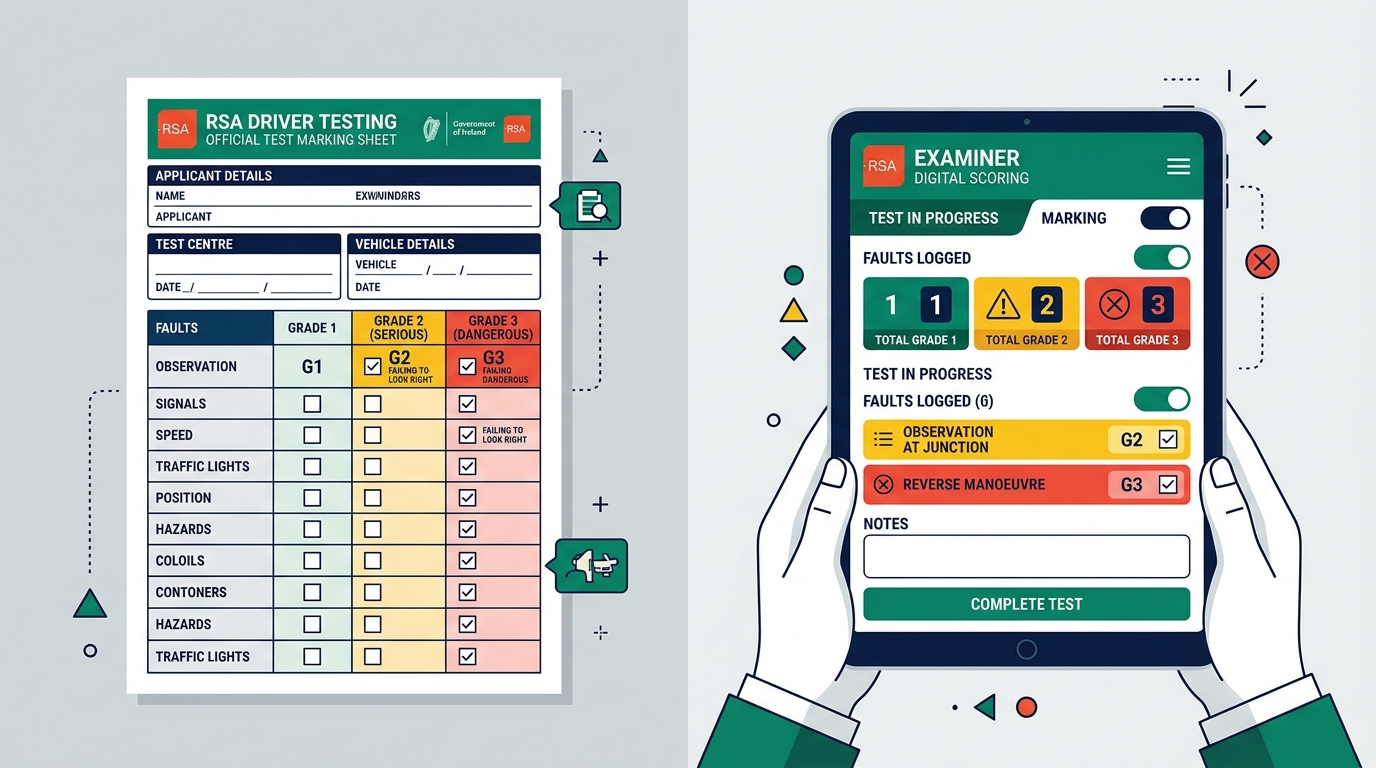
Breakdown of the official Irish RSA driving test marking sheet and digital scoring system. Learn Grade 1, 2, and 3 fault limits and how examiners score your test.
RSA Test Result & Fault Calculator
Enter marks from your mock test or result sheet to test against official RSA pass/fail thresholds.
Step 1: Record Grade 2 Faults by Heading
1. Observation & Mirrors
Blind spot checks on moving off, scanning junctions & roundabouts early, mirror routines before braking.
2. Road Position & Clearance
1-metre clearance from parked cars, proper lane selection at roundabouts, right-turn positioning.
3. Progress & Hesitation
Maintaining reasonable speed when safe, making progress at clear junctions without undue hesitation.
4. Vehicle Controls
Smooth clutch bite points, avoiding stalling, proper gear selection, steering and handbrake usage.
5. Manoeuvres (Reverse, Turnabout, Hill Start)
Control at slow walking pace, zero kerb striking, 360° scans, and zero rollback on slopes.
6. Reaction to Hazards & Signals
Anticipating pedestrian crossings, amber lights, obeying yellow box junctions and stop signs.
Step 2: Specific Fail Rule Triggers
The Official RSA Marking Standard (Making Your Mark)
During the Irish driving test, the RSA driving tester evaluates your driving using the official RSA Marking Guidelines ("Making Your Mark"). Today, examiners record faults electronically on an RSA digital tablet during or immediately at the end of each stage. Every driving action is assessed against a standardized grading scale to ensure objective marking across all test centres.
- Standardized Marking: Every tester follows the exact same RSA scoring rubric across Ireland.
- Instant Results: The tablet calculates your final score and the detailed breakdown is emailed to you.
- Transparency: Faults are categorized under specific headings (Observation, Position, Progress, Vehicle Controls, Manoeuvres, Reaction).
Grade 1, Grade 2, and Grade 3 Fault Definitions
The RSA classifies all candidate driving performance into three distinct fault grades:
- Grade 1 (Minor / Non-Recorded): Faults that fall between 0% and 35% on the RSA assessment scale. These minor deviations are considered non-serious and are not recorded on your final result sheet.
- Grade 2 (Serious): A fault that represents a serious error or omission that could compromise road safety or inconvenience other road users. Examples: missed blind-spot check on moving off, improper lane position on a roundabout, or lack of progress when clear.
- Grade 3 (Dangerous / Potentially Dangerous): An action or situation that creates an immediate hazard, forces the tester or another driver to take evasive action, strikes a kerb violently, or breaks a red light. A single Grade 3 fault results in an automatic test fail.
The Exact Failure Thresholds on the RSA Marking Sheet
Under the official RSA driving test scoring system, a candidate fails the driving test if they accumulate ANY of the following fault totals:
- 1 or more Grade 3 faults (Immediate Fail).
- 4 of the same Grade 2 fault for a single aspect (e.g. 4 Grade 2 faults for Observation at Roundabouts).
- 6 or more Grade 2 faults under the same heading (e.g. 6 Grade 2 faults under "Position").
- 9 or more Grade 2 faults overall across the entire driving test.
- Passing Standard: To pass, you must have 0 Grade 3 faults, fewer than 4 identical Grade 2 faults for any single aspect, fewer than 6 Grade 2 faults under any single heading, and no more than 8 total Grade 2 faults.
Key Heading 1: Observation & Mirrors
Observation is the most frequently penalized heading on the RSA marking sheet. The tester marks: (1) Moving Off: 360-degree scan and looking over the right shoulder before releasing the handbrake; (2) Junctions & Roundabouts: Looking right and left well before entering; (3) Mirror Checks: Checking interior and wing mirrors before signaling, braking, or changing road position; (4) Manoeuvres: Continuous over-the-shoulder looking through the rear window while reversing.
Key Heading 2: Road Position & Clearance
Position faults are assessed across: (1) Normal Road Position: Keeping approximately 1 metre from the left kerb in normal flow; (2) Clearance from Hazards: Giving at least 1 metre (door-width) clearance when passing parked cars or cyclists; (3) Turning Right / Left: Positioning correctly near the centre line when turning right without cutting corners; (4) Roundabouts: Selecting the proper approach lane (left for straight/left, right for right turns) and maintaining spiral lane discipline.
Key Heading 3: Progress & Speed Management
The test assesses making reasonable progress when the road ahead is safe. Common faults include: (1) Undue Hesitation: Waiting at clear roundabouts or junctions when a safe gap is readily available; (2) Progress on Straight Roads: Driving 35 km/h in a 60 km/h or 80 km/h zone without hazard justification; (3) Complying with Speed Limits: Exceeding posted limits or driving too fast for rain, fog, or narrow residential streets.
Key Heading 4: Vehicle Controls & Manoeuvres
The tester marks your mechanical handling: (1) Clutch & Gears: Finding bite points without stalling, avoiding coasting with the clutch pressed, selecting the proper gear for road speed; (2) Steering: Smooth pull-push or hand-over-hand steering without dry steering while stationary; (3) Handbrake: Applying the handbrake whenever stopping on gradients or prolonged pauses; (4) Manoeuvres: Completing the Turnabout, Reverse Around the Corner, and Hill Start at walking pace with zero kerb collisions.
Key Heading 5: Reaction to Hazards & Traffic Signals
You must demonstrate proactive anticipation: (1) Traffic Lights: Anticipating amber lights without harsh emergency braking; (2) Pedestrian Crossings: Yielding promptly to pedestrians at zebra or pelican crossings; (3) Yellow Box Junctions: Never entering a yellow box unless your exit road is clear (except when turning right).
Frequently Asked Questions
How many Grade 2 faults are allowed on the Irish driving test?
You are allowed up to 8 Grade 2 faults overall. However, you will fail if you receive 4 of the same Grade 2 fault for one specific aspect, 6 or more Grade 2 faults under the same heading, or any single Grade 3 fault.
What is the difference between a Grade 2 and Grade 3 fault in Ireland?
A Grade 2 fault is a serious error or omission (such as poor observation or incorrect positioning) that could cause inconvenience or potential danger. A Grade 3 fault is a dangerous or potentially dangerous action that poses an immediate risk or requires examiner intervention, causing an immediate test fail.
What is the most common reason for failing the Irish driving test?
According to RSA testing data, the most common reason for failure is poor observation at junctions and roundabouts, followed by incorrect road positioning and lack of progress (unnecessary hesitation).
Does the RSA examiner have a pass or fail quota in Ireland?
No. The RSA strictly denies any quota system. Examiners assess every candidate purely against published RSA driving standards. If your driving meets the passing threshold, you pass regardless of how many other candidates passed that day.
When do I receive my test result sheet?
At the end of the test, the examiner will explain the result verbally in the test centre and show you the marked faults on their tablet. A full digital copy of your test report marking sheet is emailed to you shortly after.
Official RSA & Department of Transport Sourced References
All test marking thresholds, legislation, and manoeuvre criteria are derived from current official Irish Road Safety Authority (RSA) and Department of Transport publications.
Turn your result sheet into a practice plan
Add the fault categories from your test report to see focused study links and a local-practice next step. Your report details are not included in analytics events.
Open Test Report Analyzer →Know the route before test day.
Turn nervous drives into focused practice. Follow independent route patterns with clear, turn-by-turn voice guidance on iPhone and Android.


Built for iPhone & Android
Practise at your own pace