
Reverse Around the Corner (Irish Driving Test): Step-by-Step RSA Guide
Master the reverse around a corner manoeuvre for the Irish driving test. Sourced from official RSA Marking Guidelines with step-by-step reference points, mirror checks, and Grade 2 fault prevention.
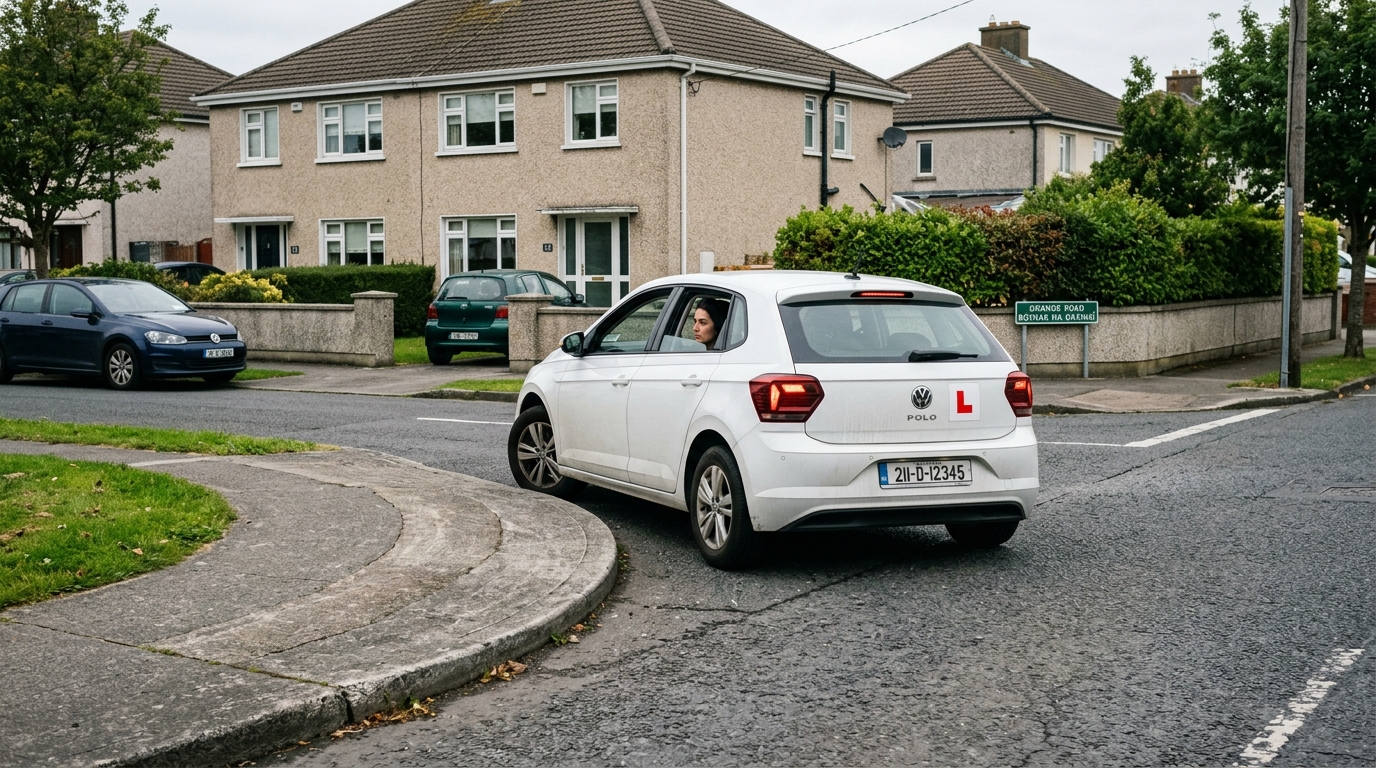
Master the reverse around a corner manoeuvre for the Irish driving test. Sourced from official RSA Marking Guidelines with step-by-step reference points, mirror checks, and Grade 2 fault prevention.
5-Stage Visual Maneuver Guide
Official RSA Marking & Reference Points
Drive past the corner junction and pull up parallel to the kerb, approximately 1.5 to 2 car lengths past the bend. Maintain a neat 30–45 cm distance from the kerb. Secure with handbrake, select neutral.
Rear-view and left door mirror check before pulling in; indicate left if needed.
Are you stopping smoothly, parallel to the kerb, without clipping or climbing it, and leaving enough working space before the corner?
Grade 2 (Position / Stopping): Stopping too close to the corner (<1 car length) or stopping too far out in the road (>60 cm from kerb).
Line up your vehicle parallel to the straight road before putting it into reverse. A crooked start makes the entire manoeuvre harder.
What the RSA Examiner Is Assessing
During the Irish driving test, the reverse around a left-hand corner is one of the mandatory slow-speed manoeuvres. Under the official RSA Marking Guidelines, the examiner marks you across three critical headings: Observation, Position, and Vehicle Control. The examiner does not expect speed; they require total control at a slow walking pace, continuous all-round observation, and maintaining a steady 30 to 45 cm distance from the kerb without mounting or drifting.
- Observation: Full 360-degree check before moving, plus checking the front swing into the road.
- Position: Keeping parallel and within 30–45 cm of the kerb without mounting or swinging wide.
- Control: Steady clutch bite point at walking pace, with right foot hovering over the brake.
- Priority: Immediately stopping for any approaching pedestrian, cyclist, or vehicle.
Phase 1: Approach & Initial Setup
The examiner will say: "Drive past the junction on the left and pull in parallel to the kerb about 1.5 to 2 car lengths past the corner." Prepare early using the MSPSL routine (Mirrors, Signal, Position, Speed, Look). Check your interior and left door mirror. Signal left only if it benefits other road users. Stop parallel to the kerb, approximately 30 to 45 cm away. Apply the handbrake and select neutral.
Phase 2: The Mandatory 360° Observation Scan
Before releasing the handbrake or turning the wheel, you must perform a comprehensive 360-degree observation scan. Looking only in your door mirrors is an immediate Grade 2 fault. Move your head deliberately in this exact sequence: (1) Left blind spot, (2) Left wing mirror, (3) Forward through windscreen, (4) Interior rear-view mirror, (5) Right wing mirror, (6) Right blind spot over your right shoulder, and (7) Directly through the rear window.
- Rule of Priority: Reversing vehicles never have right-of-way under Irish traffic law.
- If a car emerges from the side road or approaches from behind, remain stationary until it passes.
- If a pedestrian steps onto the footpath near your corner, pause and wait for them to clear.
Phase 3: The Straight Reverse to the "Pivot Point"
Select reverse, find the clutch biting point, and release the handbrake. Reverse straight back slowly at a controlled walking pace. Look primarily out through the rear window while making brief glances at the left door mirror. Keep reversing straight until the curved kerb of the side road appears in the lower corner of your rear-left passenger window. This visual reference is your "Pivot Point".
Phase 4: Turning & The Critical "Front-Swing" Check
Once the kerb reaches your pivot point, smoothly steer approximately half to three-quarters of a turn to the left. As your car begins rounding the corner, the front right of your vehicle will swing out into the main carriageway. THIS IS THE HIGHEST RISK MOMENT ON THE TEST. You must look over your right shoulder and into your right wing mirror to confirm no overtaking vehicle or cyclist is affected by your front swing.
Phase 5: Following the Curve with Micro-Adjustments
Follow the curve of the kerb at walking pace. Use quick, 1-second glances into your left mirror to judge kerb distance. If the kerb is disappearing or getting further than 45 cm away, apply a slight quarter-turn left. If the rear tyre is getting closer than 15 cm to the kerb, turn a quarter-turn right. Never fixate on the mirror for more than 2 seconds; keep scanning the rear window and front street.
Phase 6: Straightening Up & Securing the Vehicle
As the car aligns straight and parallel with the new side road, briskly straighten your steering wheel. Continue reversing straight back for approximately 3 to 4 car lengths away from the junction mouth so you do not block the junction. Bring the vehicle to a smooth stop, apply the handbrake, and select neutral.
How RSA Grade 2 and Grade 3 Faults Occur in This Manoeuvre
Understanding how faults are classified on the marking sheet protects you from common mistakes:
- Grade 2 Observation: Moving without looking all around, relying only on wing mirrors, or failing to check the right shoulder during front swing.
- Grade 2 Position: Ending the manoeuvre more than 1 metre away from the kerb, or finishing crookedly.
- Grade 2 Control: Stalling while reversing, or rolling forward down a hill when trying to reverse.
- Grade 3 (Automatic Fail): Mounting or striking the kerb heavily, or forcing another road user to brake or swerve.
Frequently Asked Questions
Can I use my mirrors during the reverse around the corner in Ireland?
Yes, but mirrors should only be used for quick glances (1–2 seconds) to verify distance from the kerb. Your primary observation must be looking directly through the rear window and checking over both shoulders. Relying solely on mirrors will result in a Grade 2 fault under Observation.
What happens if a car comes behind me while I am reversing?
Under Irish traffic law, reversing vehicles never have priority. Immediately bring your car to a gentle stop and wait. Do not panic or try to rush the turn. If the other vehicle stops to wait for you, you may resume only after conducting a fresh 360-degree observation check.
Is touching the kerb an automatic fail?
Gently brushing or nudging the kerb at a very slow walking pace without mounting it is typically marked as a Grade 2 fault under Vehicle Position. However, striking the kerb hard, jolting the car, or mounting the footpath is an automatic Grade 3 fail.
How far back should I reverse into the side road?
The RSA standard requires reversing approximately 3 to 4 car lengths straight back into the side road once the car is parallel. This ensures your vehicle is clear of the junction mouth and not obstructing entering or exiting traffic.
What is the ideal distance from the kerb?
The ideal target distance is between 30 cm and 45 cm (approximately 1 to 1.5 feet) from the kerb. Staying within this zone ensures you do not risk striking the kerb while leaving plenty of room for oncoming traffic in the side road.
Official RSA & Department of Transport Sourced References
All test marking thresholds, legislation, and manoeuvre criteria are derived from current official Irish Road Safety Authority (RSA) and Department of Transport publications.
Know the route before test day.
Turn nervous drives into focused practice. Follow independent route patterns with clear, turn-by-turn voice guidance on iPhone and Android.


Built for iPhone & Android
Practise at your own pace