
Turnabout (3-Point Turn) in Ireland: Step-by-Step RSA Driving Test Guide
Master the turnabout manoeuvre on a narrow road for the Irish driving test. Sourced from RSA marking guidelines with road camber tips, 360° observations, and kerb avoidance.
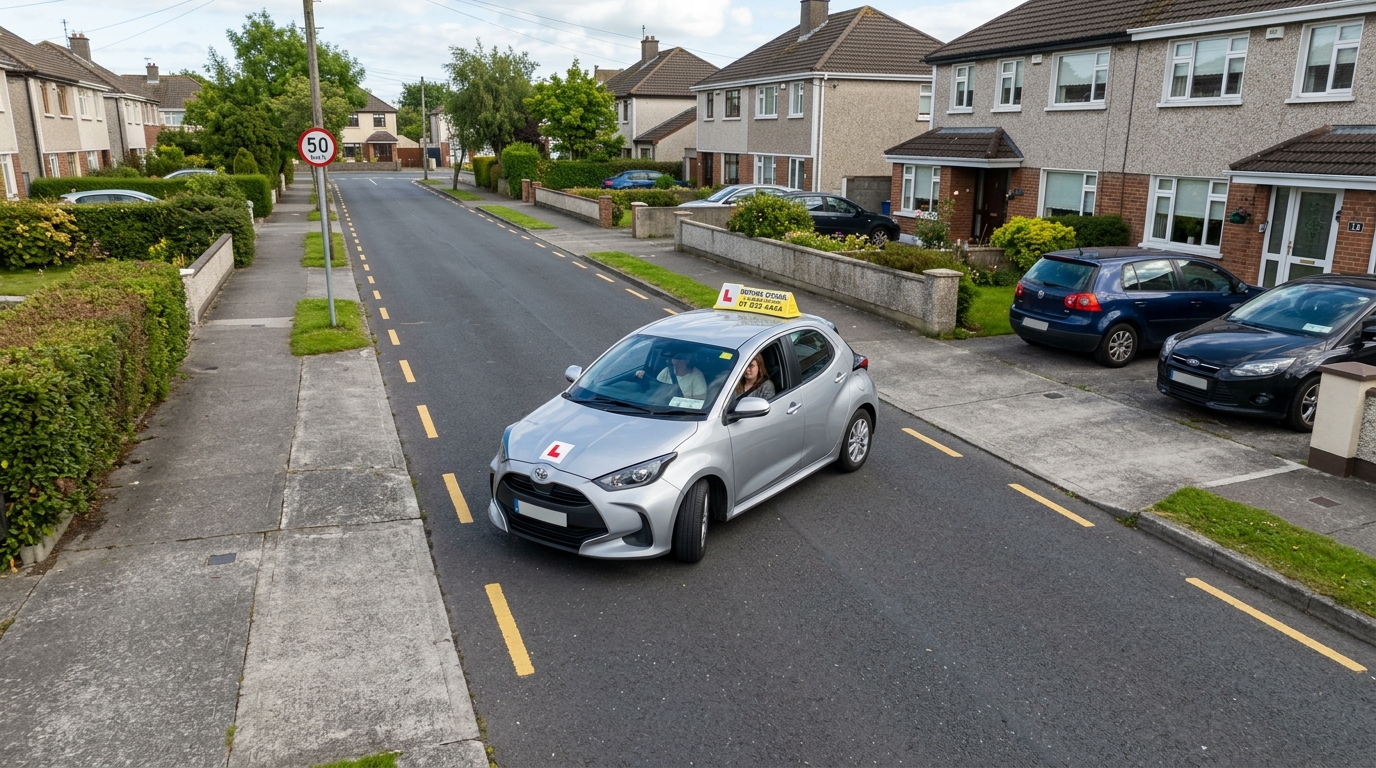
Master the turnabout manoeuvre on a narrow road for the Irish driving test. Sourced from RSA marking guidelines with road camber tips, 360° observations, and kerb avoidance.
Turnabout (3-Point Turn) Visual Guide
RSA Marking Criteria & Camber Control
Pull up on the left side of the road, parallel to the kerb. Secure with the handbrake and select 1st gear. Find the clutch bite point and perform a full 360° head check (left blind spot, mirrors, right blind spot, rear window).
Look all around, especially up and down the road. If any vehicle, cyclist, or pedestrian approaches, WAIT until they pass.
Is the candidate conducting a genuine 360-degree head sweep and giving way to other road users before beginning?
Grade 2 (Observation / Moving off): Moving off without checking the right shoulder blind spot or ignoring an approaching car.
A turnabout has no right-of-way. If another car appears while you are stopped, wait. If you are already blocking the road, pause calmly and observe.
The RSA Marking Standard for Turnabouts
The turnabout (often called the 3-point turn or turn on the road) is one of the mandatory slow-speed manoeuvres in the Irish driving test. The RSA tests your ability to turn the car around to face the opposite direction in a narrow street using forward and reverse gears with complete control, zero dry steering, and continuous all-round observation.
- Speed: Maintain a slow walking pace using clutch bite control.
- Observation: Full 360° head check before every single movement (both forward and reverse).
- Kerb Clearance: Stop approximately 30–45 cm before the kerb without touching or mounting it.
- Steering: Brisk hand-over-hand steering while the car is creeping slowly.
Stage 1: Setup & 360° Observation Scan
The examiner will ask you to pull in on the left side of the road and explain: "I would like you to turn your vehicle around to face the opposite direction using forward and reverse gears." Pull up parallel to the kerb, apply the handbrake, and select 1st gear. Find the clutch bite point. Before releasing the handbrake, perform a full 360-degree observation sweep: left blind spot, mirrors, windscreen, right blind spot, and rear window. If any road user approaches, wait.
Stage 2: Moving Forward Across (Right Lock)
Release the handbrake and let the car creep forward at walking pace. Immediately steer briskly to full right lock. As you cross the crown (centre) of the road, keep scanning left and right. Approximately 1 metre before reaching the opposite kerb, briskly steer one full turn back to the left (straightening the wheels). Stop approximately 30–45 cm before the kerb, apply the handbrake, and select reverse.
Stage 3: Reversing Back (Left Lock) & Over-Shoulder Vision
With reverse gear selected and the clutch biting, conduct another full 360° check. Release the handbrake and reverse slowly while turning the steering wheel briskly to full left lock. Look primarily through the rear window into the space you are reversing into, while frequently glancing left and right. About 1 metre before the rear kerb, steer one turn right to straighten wheels. Stop 30–45 cm from the kerb and apply the handbrake.
Stage 4: Driving Forward into Your New Lane
Select 1st gear, find the biting point, and perform a final 360° observation scan. Release the handbrake and drive smoothly forward into your normal driving position on the left side of the road. Once straight, check your interior rear-view mirror to verify following traffic and resume normal road speed.
Understanding Road Camber (Slope) on Irish Streets
Most Irish residential roads have a camber (the centre of the road is higher than the sides for drainage). This means during Stage 2 you drive uphill then downhill, and during Stage 3 the car will naturally want to roll backwards faster. Keep your right foot hovering over the footbrake at all times to prevent the car running away down the camber.
Common Grade 2 and Grade 3 Faults on Turnabouts
The RSA records faults under Manoeuvres (Turnabout):
- Grade 2 Observation: Moving without looking over both shoulders, or failing to look behind through the rear window when reversing.
- Grade 2 Position: Bumping or lightly nudging the kerb at walking pace.
- Grade 2 Vehicle Control: Turning the steering wheel while completely stationary ("dry steering").
- Grade 3 (Immediate Fail): Mounting the footpath, hitting the kerb hard, or forcing an approaching driver or pedestrian to stop.
Frequently Asked Questions
Does the turnabout have to be completed in exactly 3 moves in Ireland?
No. The RSA does not require the manoeuvre to be strictly 3 moves if the road is very narrow or blocked by parked cars. If needed, you can make it a 5-point turn. What matters is safe observation, complete control at walking pace, and not hitting the kerb.
Is dry steering penalized during the turnabout?
Turning the steering wheel while the car is completely stationary places unnecessary wear on tyres and steering components. While minor dry steering may not fail you, doing it repeatedly can result in a Grade 2 fault under Vehicle Controls (Steering). Always keep the car creeping slightly as you turn the wheel.
What should I do if a car approaches while I am across the road?
If you are already in the middle of the road, do not panic or rush. Bring your car to a gentle stop, secure it, make eye contact, and assess the situation. Most drivers will wait for you to finish. Perform a fresh 360-degree check before moving again.
What happens if I touch the kerb during a turnabout?
A gentle touch at slow walking pace without mounting the kerb is marked as a Grade 2 fault under Vehicle Position. Mounting the kerb or hitting it hard is an automatic Grade 3 fail.
How do I know when to start turning the wheel back before the kerb?
When the front of your car is approximately 1 metre (about half a bonnet length) from the opposite kerb, briskly steer one turn in the opposite direction. This straightens your front wheels so you are immediately ready to reverse.
Official RSA & Department of Transport Sourced References
All test marking thresholds, legislation, and manoeuvre criteria are derived from current official Irish Road Safety Authority (RSA) and Department of Transport publications.
Know the route before test day.
Turn nervous drives into focused practice. Follow independent route patterns with clear, turn-by-turn voice guidance on iPhone and Android.


Built for iPhone & Android
Practise at your own pace