
Hill Start Driving Test Ireland: Zero Rollback & Clutch Bite Technique
Step-by-step guide to executing a flawless hill start on the Irish driving test. Learn the exact biting point technique, handbrake release, and RSA zero-rollback marking rules.
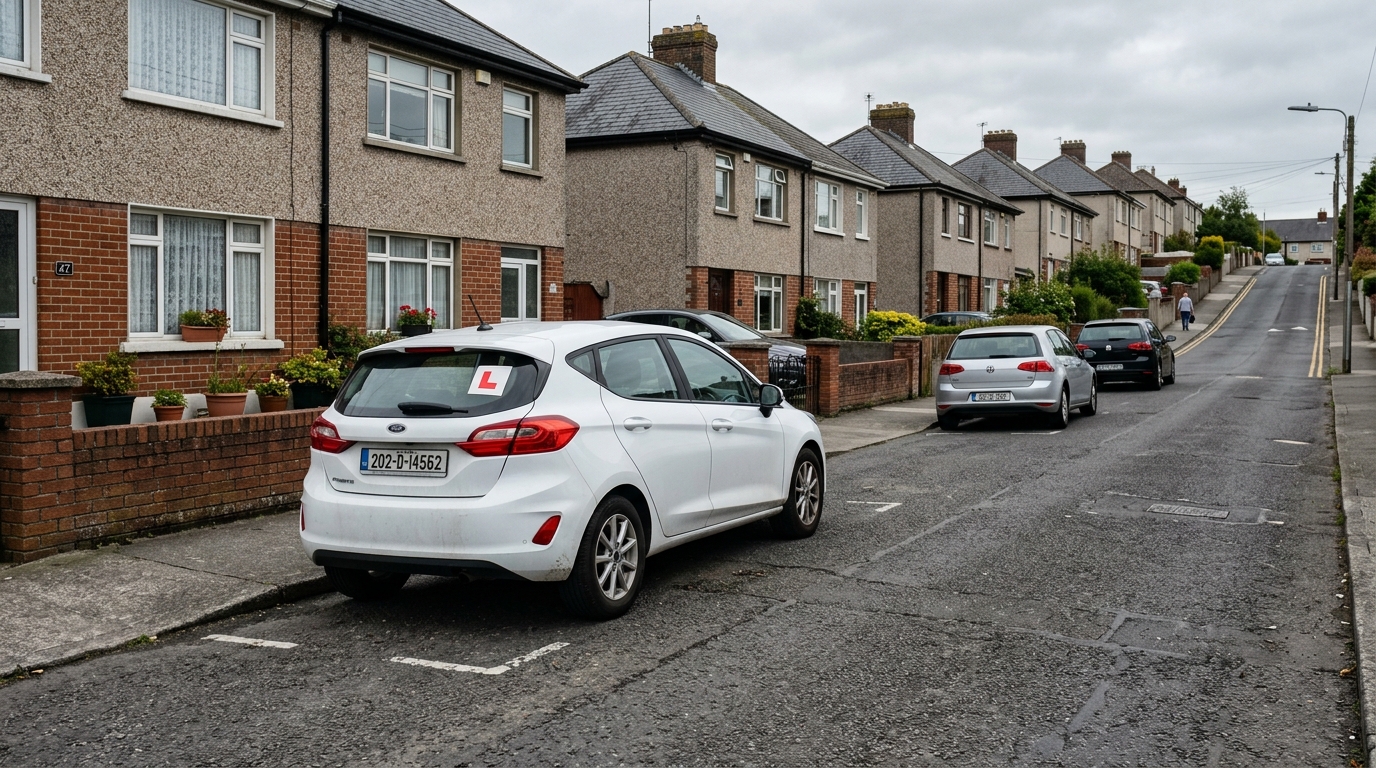
Step-by-step guide to executing a flawless hill start on the Irish driving test. Learn the exact biting point technique, handbrake release, and RSA zero-rollback marking rules.
Hill Start Masterclass: Zero Rollback Protocol
RSA Marking Guidelines & Gradient Control
Come to a smooth stop on the left side of the incline, approximately 30–45 cm from the kerb. Firmly pull the handbrake up to full tension so the car cannot roll, then select neutral. Remove feet from pedals if stationary for a pause.
Check interior and left door mirrors before stopping; signal left only if it helps following or oncoming road users.
Did the candidate secure the car firmly with the handbrake without letting it roll back even an inch upon stopping?
Grade 2 (Vehicle Control / Handbrake): Stopping on a hill and relying solely on the footbrake without applying the handbrake.
On steep Irish hills, pull the handbrake up one extra click to ensure zero slippage before resting your feet.
How RSA Examiners Assess the Hill Start
During the practical test, the examiner will evaluate your hill start under the marking heading "Moving Off (Gradient)". The test assesses your ability to coordinate the clutch, accelerator, footbrake, and handbrake smoothly on an incline with ZERO backward roll, no tyre spin, and a thorough blind-spot observation check before moving.
- Zero Rollback: The vehicle must move directly forward with no backward roll.
- Observation: Full right-shoulder blind spot check before releasing the handbrake.
- Engine Control: Steady engine revs (1,500–2,000 RPM) without over-revving or stalling.
- Smooth Progress: Transitioning cleanly into normal driving flow without hesitation.
Step 1: Securing the Vehicle on the Slope
When requested to pull in on an incline, pull up smoothly on the left side of the road approximately 30–45 cm from the kerb. Apply the handbrake firmly to the top ratchet click to ensure the vehicle is held completely motionless. Select neutral and rest your feet.
Step 2: Setting the Gas & Finding the Bite Point
Press the clutch fully to the floor and engage 1st gear. Gently press the accelerator to establish a steady engine hum (approx. 1,500 to 2,000 RPM on steeper gradients). Slowly raise the clutch pedal until you feel the biting point: the bonnet will rise slightly, the engine note will deepen, and the rear of the car will squat slightly. HOLD THE CLUTCH COMPLETELY STILL AT THIS POINT.
Step 3: Crucial Right-Shoulder Blind Spot Check
With the car primed at the bite point and your hand on the handbrake lever, check your interior rear-view mirror, right door mirror, and turn your head to look directly over your right shoulder out the driver window. Confirm no vehicle, cyclist, or pedestrian is approaching.
Step 4: Smooth Handbrake Release & Forward Drive
When the road is clear, press the button and release the handbrake smoothly downwards. Keep your left foot stationary on the clutch bite for 2 to 3 seconds as the car begins climbing the hill, then gently add more accelerator and release the remaining clutch travel smoothly.
Hill Starts at Traffic Lights and Junctions
You may also be required to perform a hill start when queued behind other traffic or stopped at a red traffic light on an incline. Always apply the handbrake rather than balancing on the footbrake or slipping the clutch for long periods, which can cause clutch burn or accidental rollback.
Common RSA Faults on Hill Starts
The RSA records faults under Moving Off (Gradient) and Vehicle Controls (Clutch/Handbrake):
- Grade 2 (Moving Off / Observation): Moving off without looking over the right shoulder.
- Grade 2 (Moving Off / Control): Rolling back a few inches before catching the bite point, or stalling without creating danger.
- Grade 2 (Vehicle Controls / Accelerator): Severe over-revving with wheel spin.
- Grade 3 (Immediate Fail): Rolling backwards more than 0.5 metres, rolling into a car waiting behind, or stalling dangerously across active traffic.
Frequently Asked Questions
Is any rollback allowed during a hill start on the Irish driving test?
No. The RSA standard expects zero rollback. Even rolling back 10–20 cm can be recorded as a Grade 2 fault under Moving Off (Gradient). Rolling back significantly or towards a vehicle behind is an immediate Grade 3 fail.
Do I fail if I stall on a hill start during my test?
Not automatically. A single stall handled calmly and safely (immediately applying the footbrake and handbrake, restarting the engine, and doing a full 360 observation check) is typically marked as a Grade 2 fault. It only becomes a Grade 3 fail if the car rolls backwards dangerously or blocks oncoming traffic without safe recovery.
Should I use the handbrake every time I stop on an incline?
Yes. Whenever you stop on a hill for more than a momentary pause (such as at red lights, pedestrian crossings, or when parked), applying the handbrake gives you total security and prevents rollback.
How much gas (RPM) should I use on a steep hill start?
On a moderate to steep gradient, aim for approximately 1,500 to 2,000 RPM (a cheerful, steady hum). This provides sufficient engine torque to carry the vehicle forward when the clutch engages.
What is the most common mistake on hill starts in Ireland?
The most frequent error is releasing the handbrake before the clutch has reached the true bite point, or releasing the clutch too quickly once the car starts moving. Remember: set gas first, find bite, check shoulder, release handbrake, and hold clutch steady.
Official RSA & Department of Transport Sourced References
All test marking thresholds, legislation, and manoeuvre criteria are derived from current official Irish Road Safety Authority (RSA) and Department of Transport publications.
Know the route before test day.
Turn nervous drives into focused practice. Follow independent route patterns with clear, turn-by-turn voice guidance on iPhone and Android.


Built for iPhone & Android
Practise at your own pace